
The Afrobeats Artist Everyone Hears But Nobody Streams
What happens when the whole country is Shazaming a song that almost nobody is actually streaming? One real artist's data has an answer — and it's a warning sign hiding inside a success story.
There's a specific kind of Afrobeats artist most casual fans have encountered without realising it: the song that seems to be everywhere blasting from a shared taxi, looping at a wedding, playing behind a skit that somehow never shows up in anyone's Spotify Wrapped.
That artist is more common than you'd think. And a recent data teardown of one independent Nigerian artist's streaming numbers shared with Vidora Data Consult and fully anonymised for this piece shows exactly why.
The Number Behind the Pattern
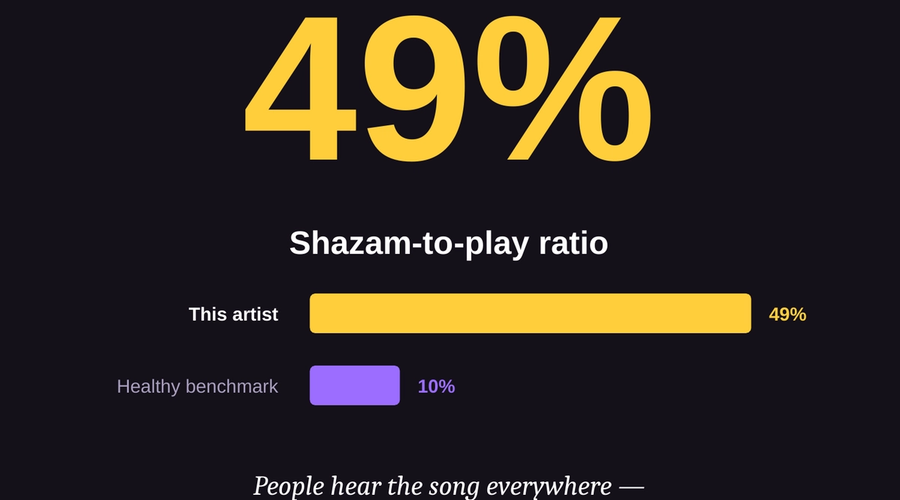
The artist's Shazam-to-play ratio sat at 49% across their catalogue. On their biggest single, it climbed to 61%. In one city, Shazam identifications actually outnumbered the song's plays outright.
For context, industry analysts generally consider a healthy Shazam-to-play ratio to be around 10%, which is enough to show a song is travelling beyond the app, while most of its audience still listens on-platform, where the artist can actually benefit: royalties, algorithmic boosts, playlist consideration, and follower growth.
This artist's ratio was nearly five times that.
"A Shazam happens in one very specific moment," says Adaora Nnamani, founder of Vidora Data Consult, the music analytics firm that conducted the read. "Someone is out in the world, hears something that grabs them, and pulls out their phone to identify it. That's real proof the music connects. But it's proof of a moment, not a relationship. It doesn't mean that person ever opened Spotify afterward."
A Hit in the Street, a Ghost on the Chart
The pattern lines up with something Afrobeats industry watchers have long suspected but rarely had numbers for: a huge amount of the genre's cultural reach happens entirely offline through radio, DJ sets, church, markets, and word of mouth in ways streaming platforms were never built to capture.
The data backs this up in two more ways.
Geography. Of the 118 countries the artist's music reached, one single home city accounted for 54% of all plays and 65% of all Shazam activity. Nigeria as a whole made up 76% of the total plays. Meanwhile, a diaspora audience spread across the US, UK, Canada, and Ghana was already streaming with zero promotional push behind it at all.
Catalogue depth. Of the seven released songs, just three accounted for 94% of all plays. New listeners arriving via the hits currently have nowhere else in the catalogue to go.
Awareness Isn't the Problem. Conversion Is.
Put together, the read tells a story that cuts against the usual narrative of an independent artist "needing more reach." This artist doesn't have a discovery problem arguably, they have more organic reach than most marketing budgets could buy. What they're missing is the infrastructure to convert that moment of street-level curiosity into something ownable: a save, a follow, a reason to come back.
"The instinct is always to chase more streams," Nnamani notes. "But when the data looks like this, more reach isn't the fix you'd just be pouring more water into a bucket that's already leaking. The fix is catching the demand that's already there."
Among the recommendations that came out of the analysis: capturing the Shazam moment with pre-save links and clear calls-to-action, directly engaging the unprompted diaspora audience, servicing the specific cities already showing outsized offline demand, and building pathways for new listeners to explore beyond the three lead singles.
Why This Matters Beyond One Artist
Cases like this are a reminder that, for all their charts, streaming dashboards were never designed to tell an artist a story, only to hand them data points. Reading the story underneath takes someone who knows what a given number, in a given context, actually predicts.
That gap between having data and understanding it is precisely what a small but growing wave of music-data consultants, Vidora Data Consult among them, has started to fill for independent African artists navigating an industry that increasingly runs on numbers most of them were never taught to read.
Vidora Data Consult provides data-driven artist analytics and growth strategies. This teardown has been fully anonymised to protect the artist's identity.